



To decrease the level of pre-operative anxiety and post-operative nausea experienced by veterans in the perioperative area using therapeutic inhaled essential oils (TIEO).
Read more: The Use of Aromatherapy to Decrease Pre-operative Anxiety and Post-operative Nausea in VeteransDATE: 2026
INSTITUTION: U.S. Department of Veterans Affairs, Atlanta VA Health Care System
TEAM MEMBERS
Akeeda Clarke RN; Rani Chiyezhan RN, CCRN; Maquitha Mitchell DNP, RN, CCRN; Jessy Thomas RN, CCRN; Jaime Young DNP, RN, CPAN, CAPA, CCRN
FRAMEWORK AND IMPLEMENTATION
The Seven Steps of Evidence-Based Practice:
- Step 0: Cultivate Inquiry
- Step 1: Ask Clinical Questions
- Step 2: Find the Evidence
- Step 3: Appraise the Evidence
- Step 4: Follow the Evidence
- Step 5: Implement the Evidence
- Step 6: Evaluate & Disseminate the Outcomes
PURPOSE
- To utilize multi-modal, nurse-driven interventions for the treatment of anxiety and nausea in the perioperative veteran patient population.
- Decrease the level of pre-operative anxiety and post-operative nausea experienced by veterans in the perioperative area.
PICOT QUESTION
Anxiety: Will the inhalation of therapeutic inhaled essential oils (TIEO) decrease the perceived anxiety score, by 25%, in veterans who report feeling anxious in pre-op?
Nausea: Will the inhalation of therapeutic inhaled essential oils (TIEO) decrease the perceived nausea score, by 25%, in veterans who score > 2 on the Apfel and report PONV in PACU?
THERAPEUTIC INHALED ESSENTIAL OILS
Therapeutic Inhaled Essential Oils (TIEOs) are a targeted, therapeutic intervention performed by inhaling essential oil through the nasal passages and lungs to influence brain and physiological properties for symptom reduction.
The olfactory system leads to brain function, including memory and emotion. Areas of the brain affected are the pyriform cortex, amygdala, and hippocampus (Tisserand Institute, 2026).
BENEFITS OF TIEOS IN THE PERIOPERATIVE AREA
- Decrease length of stay
- Cost benefit
- Increased safety
- Improved patient satisfaction
QUEASEEASE BY SOOTHING SCENTS
The method of TIEO piloted was the QueaseEASE™ QuickTAB™ by Soothing Scents. It covers a multitude of symptoms:
- GI upset
- Morning sickness
- Nausea
- Stress
- Urinary retention
TEAM EDUCATION & COLLABORATION
- Team members volunteered to be “champions” of implementation (OR, Pre-op, PACU).
- The core team was educated on the use of aromatherapy by Soothing Scents education.
- Education sessions took place at huddle and one-on-one with staff.
- Collaboration with anesthesia: the project was presented at huddle.
INTERVENTIONS
Aromatherapy for Anxiety
| Step | Action |
|---|---|
| 1. Assess risk | Veteran endorses anxiety? Ask if the veteran agrees to aromatherapy. Provide education/handout. |
| 2. Pre-score | Assess anxiety using VAS-A. Document pre-score. |
| 3. Intervention | Provide QueaseEASE™ inhaler. Instruct slow, deep breathing for about 5 minutes. Observe response. |
| 4. Post-score | Reassess using VAS-A. Document post-score. Compare pre- and post-scores. |
Aromatherapy for Nausea
| Step | Action |
|---|---|
| 1. Assess risk | Pre-op: if Apfel score > 3, place BARF Scale in chart. PACU: veteran reports nausea/vomiting (PONV). Ask if they would like to use aromatherapy; provide education handout if accepted. |
| 2. Pre-score | Assess and document nausea severity using the BARF Scale before intervention. |
| 3. Intervention | Provide QueaseEASE™. Instruct the veteran to practice slow, deep breathing for approximately 5 minutes. Do not delay notifying anesthesia of PONV symptoms. |
| 4. Post-score | Reassess and document nausea severity using the BARF Scale after intervention. |
Exclusion criteria: allergy to ginger, peppermint, and/or spearmint; symptoms triggered by scents; veteran refusal.
DATA COLLECTION
Anxiety was measured with the Visual Analog Scale for Anxiety (VAS-A) and nausea with the Baxter Retching Faces (BARF) Scale, before and after the intervention.
ANALYSIS: ANXIETY
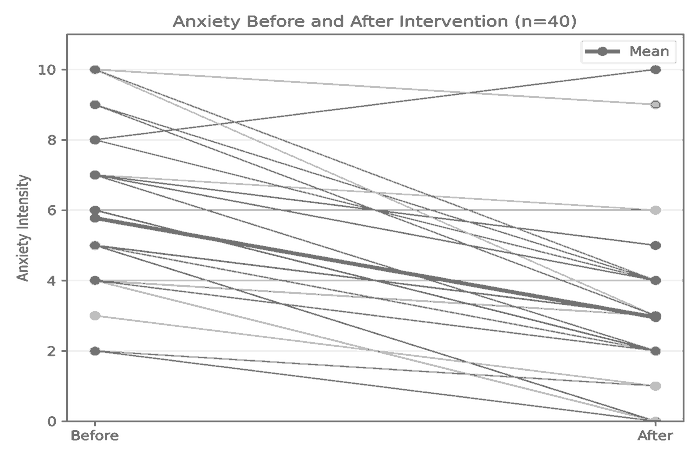
Among the 40 participants, the mean anxiety score decreased from 5.78 before the intervention to 2.95 after the intervention, representing a 49% reduction in mean anxiety. Overall, 92.5% (37/40) of participants experienced a reduction in anxiety, 5% (2/40) showed no change, and 2.5% (1/40) reported an increase in anxiety following the intervention.
ANALYSIS: NAUSEA
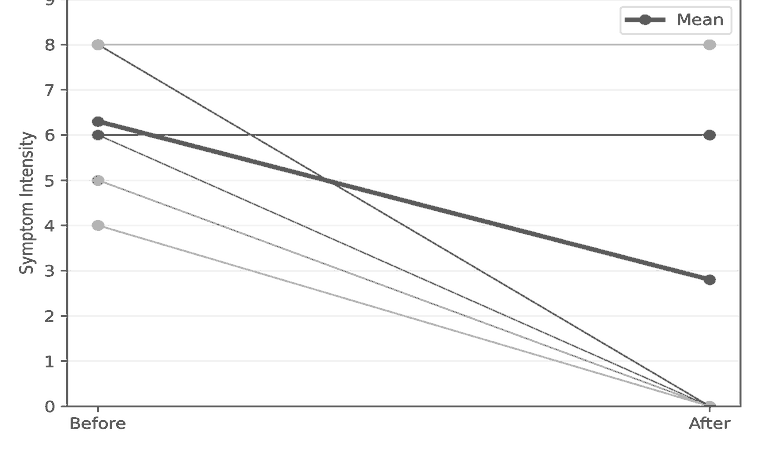
Among the 10 participants, the mean nausea score decreased from 6.3 before the intervention to 2.8 after the intervention, representing a 55.6% reduction in nausea severity. Six of ten participants (60%) demonstrated improvement, while 4 participants (40%) reported no change.
COST ANALYSIS
| Anti-emetics | QueaseEASE™ QuickTAB™ |
|---|---|
| Zofran: $0.15 to $1.35 per mL (dose 2 mL) | Cost: $2.50 per QuickTAB (lasts 2 weeks) |
| Reglan: $0.21 to $1.27 per mL (dose 5 mL) | No Black Box warning associated with use of aromatherapy |
| Black Box warnings for QTc prolongation that can lead to lethal arrhythmias |
VETERAN FEEDBACK
- “I like that it’s natural. I don’t like taking too many medications.”
- “It smells really good! I feel better already.”
- “It’s nice that you offer this.”
- “Oh, the VA is getting fancy! Aromatherapy… I’ll try it!”
- “I’m really impressed. This helped… a lot!”
REFERENCES
Ecker, A.H., Amspoker, A.B., Johnston, W., Walder, A., Lindsay, J.A. & Hogan, J.B. (2024). The role of depression and anxiety symptom severity in remotely delivered mental health care. Psychological Services, 21(1), 42-49. https://doi.org/10.1037/ser0000775
Gan, T.J., et al. (2025). Fifth consensus guidelines for the management of postoperative nausea and vomiting: executive summary. Anesthesia & Analgesia. https://doi.org/10.1213/ANE.0000000000007816
Karsten, M., Prince, D., Robinson, R., & Stout-Aguilar, J. (2020). Effects of peppermint aromatherapy on postoperative nausea and vomiting. Journal of PeriAnesthesia Nursing, 35(6), 615-618. https://doi.org/10.1016/j.jopan.2020.03.018
Macdonald-Gagnon, G., Stefanovics, E., Potenza, M.N. & Pietrzak, R.H. (2024). Generalized anxiety and mild anxiety symptoms in U.S. military veterans: prevalence, characteristics, and functioning. Journal of Psychiatric Research. https://doi.org/10.1016/j.jpsychires.2024.02.013
Maghami, M., Afazel, M. R., Azizi-Fini, I., & Maghami, M. (2020). The effect of aromatherapy with peppermint essential oil on nausea and vomiting after cardiac surgery: A randomized clinical trial. Complementary Therapies in Clinical Practice, 40, 101199. https://doi.org/10.1016/j.ctcp.2020.101199
Murphy, A.E., Belmont, S. & Mariber, N. (2022). The use of therapeutic inhaled essential oils (TIEO) as a holistic approach to decrease preoperative anxiety in ERAS gynecological surgery. Journal of PeriAnesthesia Nursing, 37(6), 787-794. https://doi.org/10.1016/j.jopan.2022.03.002
Stanley, P. F., Wan, L. F., & Karim, R. A. (2020). A randomized prospective placebo-controlled study of the effects of lavender aromatherapy on preoperative anxiety in cataract surgery patients. Journal of PeriAnesthesia Nursing, 35(4), 403-406. https://doi.org/10.1016/j.jopan.2019.12.004
Tisserand Institute. (2026). The ultimate guide to essential oil inhalation. https://tisserandinstitute.org/essential-oil-inhalation/